Agama Class
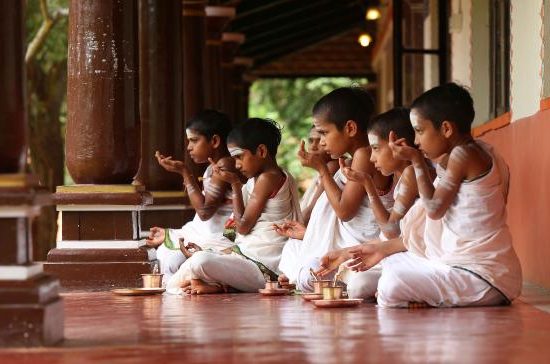
The Agama Patasala or school of Agamic study is the traditional context for the preservation of the Vedic culture and recitation. In modern India the Agama Patasala system is rapidly disappearing as fewer young people pursue these studies and also traditional sources of funding diminished.
Another class of popular scriptures are the Agamas. The Agamas are theological treatises and practical manuals of divine worship. The Agamas include the Tantras, Mantras and Yantras. These are treatises explaining the external worship of God, in idols, temples, etc. All the Agamas treat of (i) Jnana or Knowledge, (ii) Yoga or Concentration, (iii) Kriya or Esoteric Ritual and (iv) Charya or Exoteric Worship. They also give elaborate details about ontology and cosmology, liberation, devotion, meditation, philosophy of Mantras, mystic diagrams, charms and spells, temple-building, image-making, domestic observances, social rules, public festivals, etc. Divisions of the Agamas The Agamas are divided into three sections: the Vaishnava, the Saiva and the Sakta. The three chief sects of Hinduism, viz., Vaishnavism, Saivism and Saktism, base their doctrines and dogmas on their respective Agamas. The Vaishnava Agamas or Pancharatra Agamas glorify God as Vishnu. The Saiva Agamas glorify God as Siva and have given rise to an important school of philosophy known as Saiva-Siddhanta, which prevails in South India, particularly in the districts of Tirunelveli and Madurai. The Sakta Agamas or Tantras glorify God as the Mother of the Universe, under one of the many names of Devi. The Agamas do not derive their authority from the Vedas, but are not antagonistic to them. They are all Vedic in spirit and character. That is the reason why they are regarded as authoritative. And we are making some classes on saiva agama Saiva Agamas: The Saivas recognise twenty-eight Agamas, of which the chief is Kamika. The Agamas are also the basis of Kashmir Saivism which is called the Pratyabhijna system. The latter works of Pratyabhijna system show a distinct leaning to Advaitism. The Southern Saivism, i.e., Saiva Siddhanta, and the Kashmir Saivism, regard these Agamas as their authority, besides the Vedas. Each Agama has Upa-Agamas. Of these, only fragmentary texts of twenty are extant. Lord Siva is the central God in the Saiva Agamas. They are suitable to this age, Kali Yuga. They are open to all castes and both the sexes..
